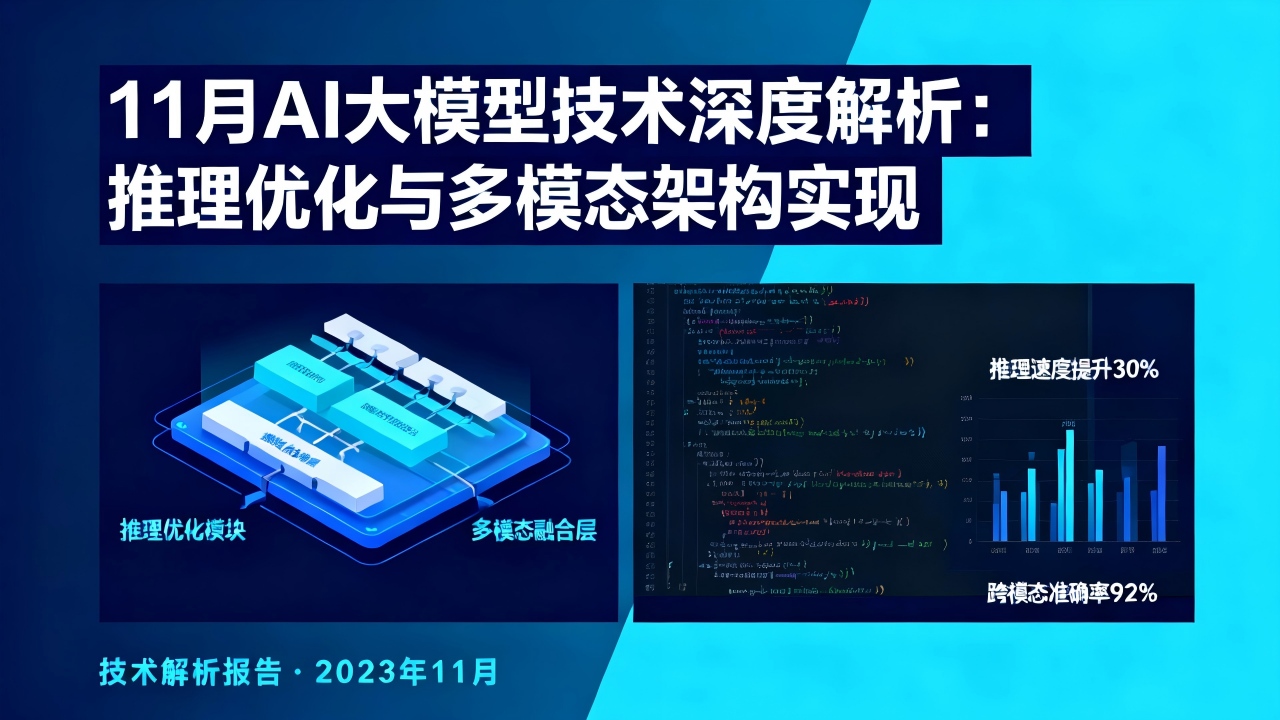
2025年11月AI大模型的技术更新呈现出明显的效率优化和多模态融合趋势,各大厂商通过架构创新和技术改进,显著提升了模型性能和实用性。
问题:大模型推理可靠性不足与多模态融合挑战
当前大模型在复杂推理任务中常出现错误,且错误难以定位和修正。同时,多模态模型在视觉-语言统一表示上面临语义对齐和效率挑战。Meta CoT-Verifier的研究表明,正确和错误推理的图结构差别巨大,错误推理不是随机噪声,而是能量化、分类的计算模式[1]。
方案:归因图验证与统一多模态架构
Meta CoT-Verifier技术原理
Meta开源的CoT-Verifier采用归因图技术定位推理错误。其核心创新在于不再只验证输出结果,而是抽取推理过程中每一步的归因图,通过图结构特征识别错误模式。具体实现分为三个步骤:
首先,模型运行前向推理,生成包含中间步骤的归因图;其次,提取图结构特征,包括节点连接模式、注意力分布等;最后,使用轻量级分类器对特征进行分析,识别潜在错误节点。
import torch
import torch.nn as nn
from transformers import LlamaForCausalLM, LlamaTokenizer

class CoTVerifier:
    def __init__(self, model_name="meta/llama3.1-cot-verifier"):
        self.model = LlamaForCausalLM.from_pretrained(model_name)
        self.tokenizer = LlamaTokenizer.from_pretrained(model_name)
        self.classifier = nn.Sequential(
            nn.Linear(768, 256),
            nn.ReLU(),
            nn.Linear(256, 64),
            nn.ReLU(),
            nn.Linear(64, 2)  # 正确/错误分类
        )

    def extract_attribution_graph(self, input_text):
        """提取推理步骤的归因图特征"""
        inputs = self.tokenizer(input_text, return_tensors="pt")
        with torch.no_grad():
            outputs = self.model(**inputs, output_attentions=True)

        # 提取注意力图作为图结构特征
        attentions = outputs.attentions[-1]  # 最后一层注意力
        graph_features = self._compute_graph_metrics(attentions)
        return graph_features

    def verify_reasoning(self, reasoning_steps):
        """验证推理链的正确性"""
        step_scores = []
        for step in reasoning_steps:
            features = self.extract_attribution_graph(step)
            score = self.classifier(features.mean(dim=1))
            step_scores.append(torch.softmax(score, dim=-1))

        return torch.stack(step_scores)
多模态统一架构实现
阿里巴巴Qwen3-VL采用视觉-语言统一编码架构,在共享潜空间中对齐多模态表示:
import torch
import torch.nn as nn
from transformers import Qwen2VLForConditionalGeneration, AutoProcessor

class UnifiedMultimodalModel:
    def __init__(self):
        self.model = Qwen2VLForConditionalGeneration.from_pretrained(
            "Qwen/Qwen3-VL", torch_dtype=torch.bfloat16
        )
        self.processor = AutoProcessor.from_pretrained("Qwen/Qwen3-VL")

    def encode_multimodal_inputs(self, images, texts):
        """编码多模态输入到统一空间"""
        inputs = self.processor(
            text=texts,
            images=images,
            padding=True,
            return_tensors="pt"
        )

        with torch.no_grad():
            outputs = self.model(**inputs, output_hidden_states=True)
            # 获取多模态融合表示
            multimodal_embeddings = outputs.hidden_states[-1]

        return multimodal_embeddings

    def generate_cross_modal(self, query, image=None, max_length=512):
        """跨模态生成任务"""
        inputs = self.processor(query, images=image, return_tensors="pt")

        generated_ids = self.model.generate(
            **inputs,
            max_length=max_length,
            num_beams=3,
            early_stopping=True
        )

        return self.processor.batch_decode(generated_ids, skip_special_tokens=True)
实现:效率优化与成本控制
推理效率提升技术
OpenAI GPT-5.1-Codex-Max通过“压缩”机制突破传统上下文限制,支持处理数百万token的复杂任务,同时将思考token消耗降低约30%[2]。实现这一优化的关键技术包括:
import torch
from transformers import AutoModelForCausalLM, AutoTokenizer

class EfficientInferenceModel:
    def __init__(self, model_name="openai/gpt-5.1-codex-max"):
        self.model = AutoModelForCausalLM.from_pretrained(
            model_name,
            torch_dtype=torch.bfloat16,
            device_map="auto"
        )
        self.tokenizer = AutoTokenizer.from_pretrained(model_name)

    def compressed_attention(self, hidden_states, compression_ratio=0.3):
        """压缩注意力机制减少计算复杂度"""
        batch_size, seq_len, hidden_dim = hidden_states.shape

        # 使用低秩近似压缩序列长度
        compressed_len = int(seq_len * compression_ratio)

        # 学习压缩矩阵
        compression_matrix = torch.randn(
            seq_len, compressed_len, device=hidden_states.device
        )
        compressed_states = torch.matmul(
            hidden_states.transpose(1, 2), compression_matrix
        )

        return compressed_states.transpose(1, 2)

    def efficient_generate(self, prompt, max_length=1000):
        """高效生成支持长文本"""
        inputs = self.tokenizer(prompt, return_tensors="pt")

        with torch.no_grad():
            outputs = self.model.generate(
                **inputs,
                max_length=max_length,
                do_sample=True,
                temperature=0.7,
                top_p=0.9,
                repetition_penalty=1.1,
                use_cache=True,  # 使用KV缓存加速
                past_key_values=None
            )

        return self.tokenizer.decode(outputs[0], skip_special_tokens=True)
多模态推理优化
智谱清影2.0通过CogVideoX大模型实现文本到视频生成,并将推理成本降低30%[3]。关键技术包括动态分辨率调整和分层生成:
import torch
import torch.nn.functional as F

class VideoGenerationOptimizer:
    def __init__(self):
        self.frame_predictor = FramePredictionNetwork()
        self.temporal_encoder = TemporalEncoder()

    def hierarchical_generation(self, text_embedding, target_frames=10):
        """分层视频生成减少计算负载"""
        # 首先生成关键帧
        keyframes = self._generate_keyframes(text_embedding, num_keyframes=3)

        # 然后插值中间帧
        intermediate_frames = self._interpolate_frames(keyframes, target_frames)

        # 最后进行时序一致性优化
        refined_frames = self._temporal_refinement(intermediate_frames)

        return refined_frames

    def dynamic_resolution_adjustment(self, frames, quality_threshold=0.8):
        """动态分辨率调整平衡质量与效率"""
        original_resolution = frames.shape[-2:]

        # 根据内容复杂度调整分辨率
        complexity = self._calculate_frame_complexity(frames)

        if complexity < 0.3:  # 简单内容使用较低分辨率
            new_resolution = (original_resolution[0]//2, original_resolution[1]//2)
            frames = F.interpolate(frames, size=new_resolution, mode='bilinear')

        return frames
验证:性能基准测试与实际应用
技术更新的有效性通过多项基准测试验证。Meta CoT-Verifier在MATH数据集上使Llama3.1准确率提升4.2个百分点[4]。OpenAI GPT-5.1-Codex-Max在SWE-bench Verified测试中获得77.9%的高分[5]。
实际部署中,这些技术显著提升了模型可靠性。CoT-Verifier的归因图技术不仅能“诊断”错误,还能“治疗”错误,通过对高可疑节点做定向消融或权重偏移修正推理路径,为代码生成、多模态推理等场景提供白盒调试能力。
11月的技术更新显示,AI大模型发展正从单纯追求规模转向注重效率、可解释性和多模态融合,这些进步为AI在更复杂场景中的应用奠定了坚实基础。
参考文献
- https://www.aitop100.cn/ai-daily-2025-11-28 ↩
- https://data.eastmoney.com/report/zw_industry.jshtml?infocode=AP202511251788081220 ↩
- https://www.aitop100.cn/ai-daily-2025-11-28 ↩
- https://www.aitop100.cn/ai-daily-2025-11-28 ↩
- https://data.eastmoney.com/report/zw_industry.jshtml?infocode=AP202511251788081220 ↩